The Body Keeps the Score: Why Your Vancouver Therapist Should Understand Your Nervous System
We’ve all been there: sitting on a comfortable sofa, explaining our week to a kind therapist, and yet… something feels stuck. You can describe your anxiety in vivid detail. You can trace your patterns back to the root.You have the “intellectual” answers to why you’re having these feelings, but your chest still feels tight, your sleep is still restless, and that familiar sense of “fight or flight” arrives even when you are technically safe.
If this sounds familiar, you’ve already experienced what Dr. Bessel van der Kolk famously termed: The Body Keeps the Score.
At Haven Collective, we believe that while talk therapy is a beautiful starting point, true healing happens when we invite the body into the room. If you are looking for a Vancouver therapist, it’s essential to find someone who doesn’t just listen to your story, but helps you navigate the biological reality of your nervous system.

The Science of “Stuckness”: Why Words Aren’t Always Enough
Dr. van der Kolk’s research revolutionized the way we understand trauma. He posits that trauma isn’t just an event that happened in the past; it is a footprint left by that event on the mind, brain, and body.
When we face overwhelming stress, our frontal lobe—the part of the brain responsible for logic and language—essentially goes offline. Meanwhile, the amygdala (our brain’s “smoke detector”) stays on high alert. This is why “talking it out” can sometimes feel like trying to extinguish a fire by describing the smoke. To put out the fire, we have to reach the parts of the brain that don’t use words.
The Architecture of Survival: Your Autonomic Nervous System
To understand why the body “keeps the score,” it helps to look at the two main branches of your Autonomic Nervous System (ANS). Think of these as the “accelerator” and the “brakes” of your internal world:
-
The Sympathetic Nervous System (The Accelerator): This is your survival engine. When you perceive a threat—whether it’s a car swerving on the Lions Gate Bridge or a critical email—this system floods your body with cortisol and adrenaline.
-
The Parasympathetic Nervous System (The Brakes): This is the “Rest and Digest” system. Its job is to help you settle, recover, and connect with others.
As Dr. van der Kolk explains, trauma and chronic stress essentially “jam” the accelerator. This isn’t a “mindset” issue; it’s a biological state where your Vagus Nerve—the longest nerve in your body—is constantly sending signals that the environment isn’t safe. So if you’ve been to therapy for years, and still feel like you’re struggling with the same things – it’s not your fault. This means that you need more than just talk therapy to move through and process the trauma you have experienced.
Why Your “Gut Feeling” is Scientific
Have you ever noticed that anxiety often comes with a “knot” in your stomach? This is because 80% of the fibers in the Vagus Nerve are sensory, meaning they send information up from the body to the brain.
When the body “keeps the score,” your brain receives a constant loop of “danger” signals from your tight chest or shallow breath. A nervous system-informed therapist helps you interrupt this loop. Instead of just talking about the anxiety, we work to manually “engage the brakes,” teaching your Vagus Nerve that it is finally safe to settle.
Finding Your “Window of Tolerance”
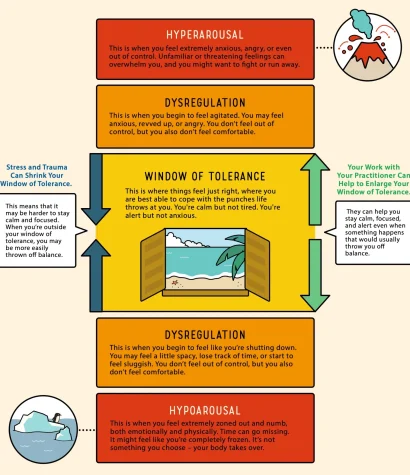
In our Kitsilano counselling practice, we often guide clients toward their Window of Tolerance. This is the physiological “sweet spot” where you feel grounded and capable of processing emotions without becoming overwhelmed.
-
Hyper-arousal: Feeling “on edge,” irritable, or hyper-vigilant.
-
Hypo-arousal: Feeling numb, unmotivated, or “checked out.”
By bringing gentle curiosity to these states, we help you expand this window. We aren’t here to “fix” your reactions, but to help you reclaim the ability to feel safe within your own skin.
Gentle Tools for the Journey: EMDR and Somatic Therapy Support
If you’ve felt that traditional talk therapy has reached its limit, specialized modalities like EMDR (Eye Movement Desensitization and Reprocessing) can offer a way forward. Unlike talk therapy, which relies on the logical “top-down” brain, EMDR is designed to bypass the analytical mind and help the “emotional brain” finally release stored stress. By using bilateral stimulation (like guided eye movements, tapping or buzzers), we help your brain reprocess traumatic memories so they no longer feel like they are happening in the “here and now.”
Your first session isn’t a performance or a deep dive into your hardest moments—it’s a chance to try a new therapy and see how if it feels like a fit for you. Not everyone enjoys or connects with EMDR therapy, and so we also offer alternative trauma-processing therapy options at our counselling practice as well.

The Language of the Body: What is Somatic Therapy?
If EMDR helps the brain “reprocess” the past, Somatic Therapy helps the body “release” it in the present. The word soma is Greek for “body,” and in a therapeutic context, it refers to your internal, lived experience. While traditional therapy stays in the realm of stories and thoughts, a somatic approach invites you to notice the “felt sense”—the physical sensations of your emotions as they arise.
During a session at Haven, this might look like slowing down to notice a sudden tightness in your chest or a restless energy in your legs. We aren’t just “talking about” your stress; we are tracking it through your nervous system. By using gentle techniques like grounding, resourcing, and titration (processing small “bits” of tension at a time), we help your body complete the “stress response” it never got to finish. This is how we begin to shift those “stuck” patterns of fight, flight, or freeze.
Whether you are seeking a neurodiversity-affirming therapist who honours your unique sensory profile, an EMDR therapist in Vancouver to help navigate past trauma, or Somatic Therapist in Kitsilano we move at your pace.
Find a Safe Place to Land
You don’t have to keep carrying the “score” of your past alone. Whether you’re navigating the pressures of life in Vancouver or healing from deep-seated trauma, there is a way to feel at home in your body again. If this blog resonated with you we’d love to support you in your mental health and healing journey. Feel free to reach out to our team and set up a free consultation call with one of our counsellors.